Wednesday, May 13, 2015

Collaboration & Soul Food!

Four Different People, One Ohio Small Town 

& A Dog=Soul Food


How do four very different people connect for an amazing collaboration that feeds one's soul?  Add a dog, the sea, endangered species and you have a fantastic blend of creativity and passion.  All four of the humans, a marine biologist, firefighter/dog trainer, photographer and videographer/story teller attached to The Tau Project are passionate about their craft and all came from a small town in Ohio, Bellbrook.  When you bring that passion together for a greater cause the results are incredible.   

The idea of a dog that detects sea turtle nests was the brain child of Nick Falzerano, the photographer, while on vacation in Hawaii and watching Cheryl King, the Marine Biologist, search for nests for miles on the beach.  He then asked Athena Haus, the firefighter/dog trainer, if it was possible to train such a dog.  Of course it is possible and from that came a journey of a lifetime for each of us.  You add Tau, the cool little Australian Cattle dog, and Bobby Lindeman, the Story Teller, with his daughter's voice and a brilliant vision evolves!  

Our goal is not only to get Tau to Maui to save sea turtles but to also teach the next generation about the eco system, animals, biology and science.  We all feel very strongly that children are the future and can make a difference in the World we live in when presented with knowledge and education.  Help us feed our souls, save a species and teach the next generation about ecology.  

Will you join us?


Tuesday, May 12, 2015

The Art of Balance


The Wisdom of Tau


  What can a little dog possibly teach the human about life?  So many obvious lessons if we just pay attention, absorb and learn!
  
Tau has the  wisdom of a Buddha.  He always lives gleefully to embrace the moment while enthusiasm and joy oozes from his soul.  His wiggly, wiry body vibrates with excitement for any new task I throw at him.  Tau is a good sport and never stops trying.  If he fails, he picks himself up and tries it again.  Such simple practices but yet so complicated for the human mind to grasp and apply.  I am learning everyday to be less serious and though I am routinely humbled by the dogs I have the honor to work with, this little sea hippy makes me live a more mindful existence with his exuberance for life.  


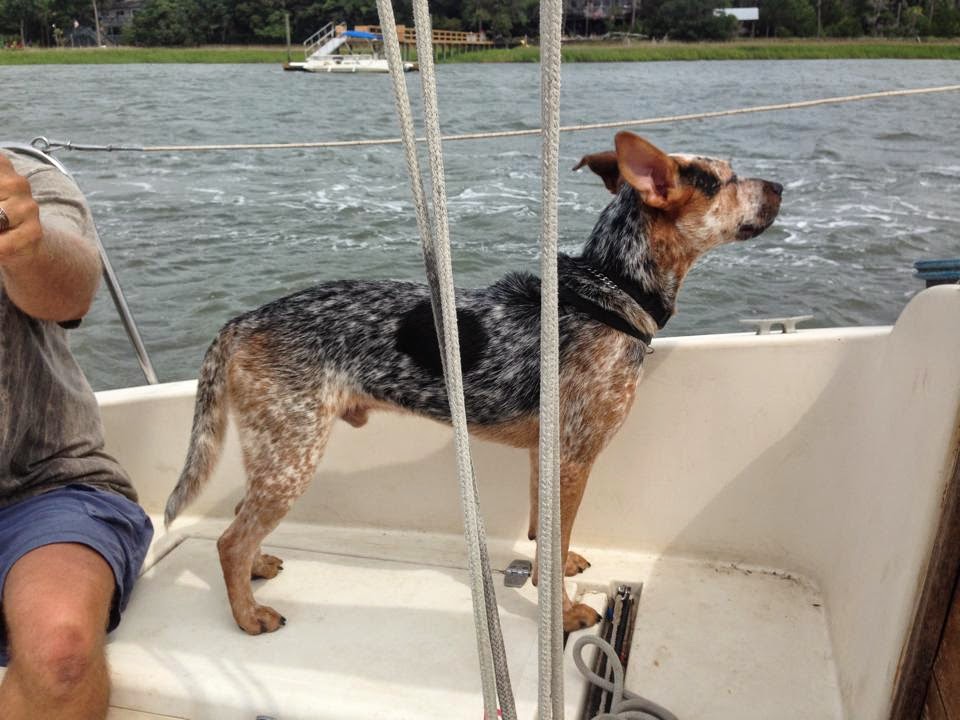
Tau Sailing in Charleston, S.C.
Tau, full of wisdom.
The cure for anything is salt water-
sweat, tears or the sea-Isak Dinesen
Tau has had many opportunities to embrace his new life by the ocean.  He loves riding on a boat and is content with the briny air blowing in his face.  It is as if he was meant to follow this calling and be a dog of the sea.  Although water sports are a fun addition to Tau's training regime for both of us, they are crucial to making his transition of "Honu Hound" a seamless one.  He will be expected to go where Cheryl goes, regardless of transit.  He will need to be confident and willing to work regardless of how he got to his final destination.  Cheryl will live and love Tau, they will be constant companions so this means he will need to be able to accompany her when she is at work and play.  The two of them are soul mates in their quest to detect and protect these beautiful sea creatures but will also be bonded by their down time adventures.  Tau will learn to sit on the kayak, a row boat and on a paddle board.  All of these means of aquatic entertainment could be apart of his daily life.  He will learn to search for the honu after being transported via all these vessels and he and Cheryl will learn to trust each other while embracing the beauty of Hawaii.


Saturday, May 9, 2015

Will you join us in getting Tau to Maui?!


Will You Join Us?


Tau has a go fund me page to help us get him to Maui and to cover his lifetime expenses so that Cheryl can concentrate on saving the Honu (sea turtles.) Please consider a donation to help us get Tau to Maui so he can start working with Cheryl.  


Friday, May 8, 2015

Tiny Bubbles

Bubbles and Turtles...

How wind currents affect scent.


Imagine how dandelion seeds are carried along the air when blown....this is how scent is carried as well.  Why is this important when teaching a dog to detect odor?  Because sending a dog into and across the wind will often times assist them in detecting a scent with greater ease.  Physics is behind much of what we know in odor theory.  Warm air rises while cool air sinks.  Cold and moisture make air heavier (think of fog or a marine layer-as the sun comes up the thick layer dissipates.  When there is no movement in the air, scent becomes diffuse making it more difficult to determine odor location because, the scent moves in all directions evenly from its source.  Air that moves in a straight line is often not affected by objects in its path but continues linear around the object and then back into a straight line.  Turbulent air moves very chaotic in flow and around objects making conditions more challenging as well.  As the ground gets warm, air rises up and as it gets cool the air falls much in the way water flows.  Odor will often times disperse out into a cone shape from the source.  This is why you will often see search dogs moving in a zig zag pattern while searching. 

Why is this important to a handler?  Because handlers can use the air, time of day, wind, terrain to their advantage and for more effective time management.  The same applies when using a dog for conservation efforts.  There are various ways to determine which way the wind is blowing.  Some handlers will use visual cues such as a windsock, flagging tape or flags.  Others carry small bottles of powder that makes a plume.  I sometimes use powder but my preference is bubbles.  I buy the little tubes of heavy duty bubbles that I can carry with ease. Those tiny bubbles show me many things and take longer to dissipate then the powder.  They tend to move with the airflow longer and are light.  The down side of using bubbles is they can spill or dry out between exercises and they freeze in cold weather so powder is a good back up.  

Who doesn't love bubbles?  

Tiny bubbles & Tau

Wednesday, May 6, 2015

Visiting the Vet!


Tau had to get some of his routine vaccines this weekend to prepare him for his journey to Hawaii.  They have very strict guidelines for rabies prevention and to avoid having to quarantine, Tau he must have a OIE-FAVN blood test that is sent to a lab at Kansas State University.  He is not allowed into Hawaii for 120 days after the test is received by the lab and must have had two rabies vaccines prior to getting the blood test.  There is a 3 week waiting period between vaccines and they must have a signed certificate for both vaccines on file as well as a health certificate within fourteen days of our planned arrival. Tau has had the rabies vaccines but unfortunately there was no signed certificate.   The blood test can be accomplished after the second rabies vaccination in 21 days.  He is required to have a micro chip for identification purposes as well.  The chip is inserted into his shoulder and the ownership information will be transferred to Cheryl once he is presented to her. Tau is a good sport and enjoyed the attention from the vet and her staff.  


Checking Vision

Teeth and Gums Look Great!

Ouch! I am a good sport!

Friday, May 1, 2015

Our Task: Finding The Perfect Dog For The Job!

The Assignment!

What's in a breed? 

Tau and his sisters

When we decided to pursue this project we intended  to use a German Shepherd. After talking with Cheryl, I realized that we needed a smaller, robust breed with a balanced nature.  After some thought I realized the Australian Cattle Dog would be the perfect breed.  

The Australian Cattle Dog is a robust, smaller framed dog with a lot of energy.  They were originally bred for the Australian Beef Industry and were crossed with dingos and blue merle collies.  Pups from these litters were then crossed with a male dalmatian making the merle color into red and blue speckle.  These dogs were originally called Australian Heelers but are also known as Queensland and Blue Heelers today.  In 1980 the Australian Cattle Dog was accepted in the American Kennel Club miscellaneous class and later moved to the working group where they remain today.  

These little dynamos have a rough coat and tolerate high temperatures well. They are a herder, need a job, are intelligent, well rounded and have high energy.  They are small in structure and are agile.  The perfect combination for a dog that will spend his days and nights on the beaches of Maui.  

The task was to find a perfect dog for the job.  I began scouring rescue groups in search of a puppy or younger dog who could be trained to find odor.  After several months of searching a litter of pups were going to be surrendered and needed a foster.  I found myself with five flea infested rolly polly pups who needed a good bath, vaccines, wormer and some antibiotics for coccidia.  The pups were isolated from my other dogs until they were healthy. This litter had four females and one little male.  In the quest for the perfect Honu hound I also found a happy older male who needed his forever home.  He was successfully placed with a family as a companion to a preteen who needed a running buddy. 

The puppies were each screened for personality, agility, play drive, hunt drive and fearlessness.  After several weeks of observation two remained, the little male (orange puppy) and a female (pink puppy) while the other three sisters found their forever homes.   After a couple of months it was clear that the little boy was going to be the choice as Tau, our "Honu Hound" and his sister was placed in her loving new home.  Tau was the lone ranger and quickly adapted to his training regime and easily adapted to our rowdy pack of four and two legged creatures!  


Thursday, April 30, 2015

What the Dogs Nose Knows!


What Does the Dogs Nose Know? 


Dogs use their nose in the same way humans might use their hands. A dog's nose can detect particles in parts per trillion. They can have 300 million olfactory receptors in their noses compared to the human beings meager 5-6 million. The dog's portion of their brain that is dedicated to smell is roughly 40 times greater than humans. When a human breathes, we breath and smell at the same time. We have a small area on the top of the nasal cavity that gives us our sense of smell as we breath air in. When a dog exhales, the exhaled air goes through slits in the sides of their nostrils that allows fresh scent to be taken to their olfactory sensors even while they exhale. Dogs can wiggle their nostrils independently helping them to determine which nostril an odor arrived in and aids them in locating the source of odors. That is why you see them weave back and forth across the odors invisible trail.


This unique sniffing ability is why dogs are used to detect many different odors including, explosives, drugs, insects, people, cancer, animals and many other things. When a dog exhibits the right behaviors and is then paired with the appropriate human handler, they can be invaluable in finding what might take us days or weeks and sometimes the human may be unable to detect them at all. 


Finding the right dog for the job can be challenging but fortunately for the Honu, we found the right hound.